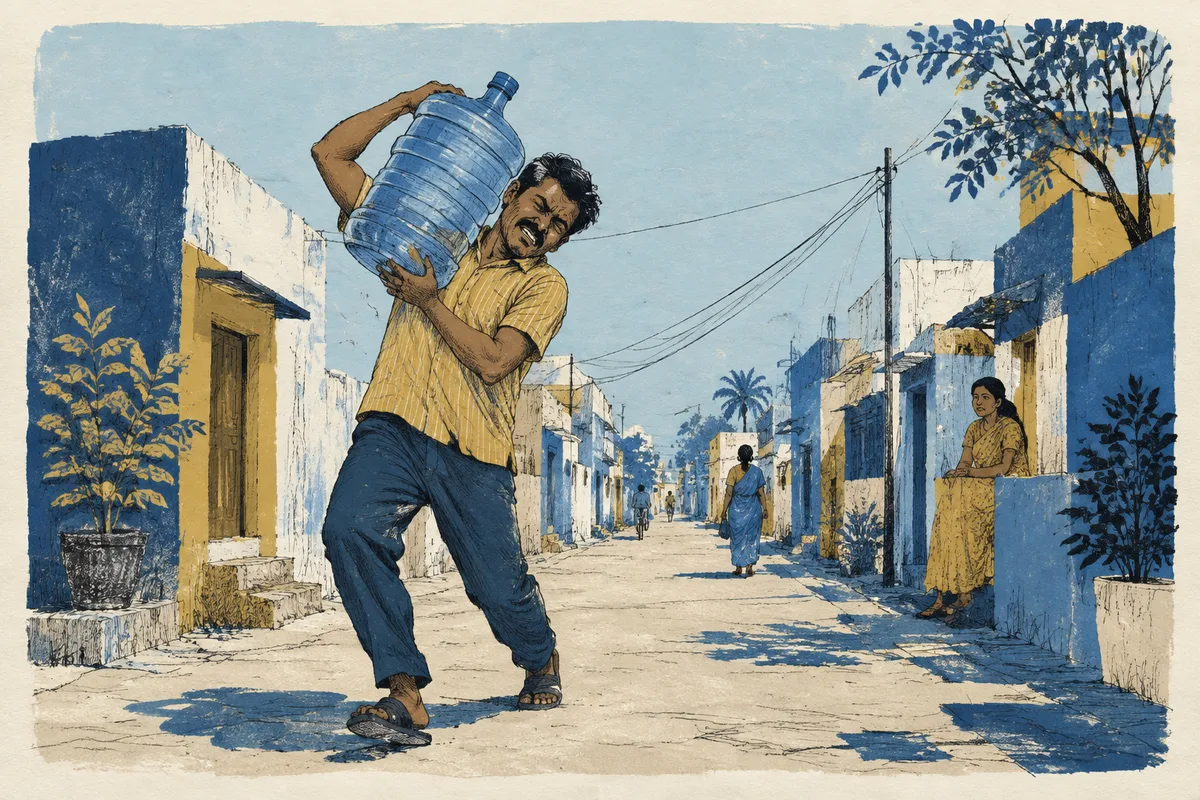
In one household account, 20 litres of water cost ₹10. Getting it home cost another ₹30–35 and the water lasted about a day.
The water was cheap. Reaching it was not. A small daily errand became the larger bill and the larger piece of work.
Cheap water can still be expensive to reach
Low unit price does not guarantee low household cost. Distance, carrying time and transport can turn a cheap refill into a daily logistics task.
One account is not enough to establish a neighbourhood market. We still need to know how many households share the route, what they already use and whether a compliant supplier can serve them safely.
The usual moment this begins is when the next refill is needed. What follows is recurring transport and time burden with constrained access.
The daily trip is part of the price
Picture someone carrying or arranging a can every day. A nearby refill point may be affordable, but a missed bus, paid ride or long walk changes the cost immediately.
This is one reported household, not proof that a whole neighbourhood has the same problem.
What is supported by evidence—and what is still only a hypothesis?
What the evidence says
Episode 16 reports a 20-litre refill at ₹10 plus ₹30–35 transport, reportedly lasting one day.
Receipts and the allocation of transport cost are unavailable.
Other complaints and subscription offerings are comparison leads, not proof of this route.
What we know
- one reported household refill
- ₹10 water + ₹30–35 travel Reported in source · not a typical price
- Evidence level
- E1 Repeated signal
- Field interviews
- Not completed Proposed in the next test
Counterargument: Existing delivery, shared transport or a subscription may already be cheaper. A dense profitable route may not exist.
Can one route pay for itself?
A delivery route only works if household price covers water handling, transport, labour, container risk and owner time. The illustrative model leaves little room for a dispersed route or failed delivery.
₹10 water plus ₹30–35 transport was reported for one refill. The avoidable share is unknown.
Who might pay: The household pays; route-operator willingness is unknown.
| Price to test | ₹40 |
|---|---|
| Direct cash cost | − ₹32 |
| Contribution before owner time | ₹8 |
| Owner time | 0.04 hours × ₹150 |
| Contribution after owner time | ₹2 |
These numbers are not a forecast. They make the hypothesis measurable and keep weak economics visible.
How households get the water now
The reported household collects cans from a plant. Existing delivery services, shared collection and purifier subscriptions may already work for other households; their local price and availability are unobserved.
Why delivery is harder than it sounds
Water delivery sounds simple until the route is spread out. Heavy cans, safe containers, deposits, failed deliveries and small orders can make a helpful service expensive to run.
Distance and low route density may increase last-mile cost. Upfront equipment costs may restrict alternatives.
What could make a test easier: An existing authorized supplier and clustered route might lower delivery cost.
The opening depends on homes being close together
A gap may exist where several households already buy refills from the same credible supplier but pay separately in time or travel.
Route density is the key. A convenient service with scattered stops can cost more than the problem it tries to remove.
Route coordination
Cluster households and time one compliant delivery route.
Weakness: Thin contribution disappears if homes are dispersed.
Compare alternatives
Assess delivery and subscription options already available.
Weakness: Availability and upfront costs vary.
Practical boundary: Supplier and local delivery or storage obligations must be checked. Possible for coordination with established supplier capacity.
How we’d test this for ₹3,500
Start with evidence, not a product. The experiment should answer one decision before any larger commitment.
- Participants
- 10 households · 2 suppliers · one route
- Time
- 7 days
- Research budget
- ~₹3,500
- Owner time
- 16 hours
Can one verified supplier and one compact route cover labour at a household price that improves on the current alternative?
- Verify supplier scope and permissions.
- Interview households and inspect receipts where available.
- Time a route and obtain labour-inclusive quotes. No water sales.
Continue if
- 6 of 10 show recurring access cost.
- 5 are on one serviceable route.
- The quote leaves non-negative contribution after owner time.
Stop if
- Supplier cannot be verified.
- The route is too dispersed.
- Total cost exceeds the current alternative.
Will you test this?
These are our proposed decision rules, not industry benchmarks.
What could make the route unsafe or uneconomic
Water quality, container hygiene, deposits and local permissions are hard boundaries. Even with safe supply, heavy loads and scattered homes can erase the margin.
- Supplier quality, container hygiene and deposits.
- Heavy-load delivery, dispersed homes and unreliable route costs.
If nobody will pay for this, it is not a business—just a real problem.
Evidence snapshot
Opportunity snapshot
A public view of what is known before a solution is proposed. It is not a market-size or margin claim.
- Pain / severity
- Consequence reported; prevalence is not established.
- Who pays
- The household pays; route-operator willingness is unknown.
- Current alternatives
- The reported household fetches cans from a plant. Existing delivery or purifier subscriptions may be alternatives.
- Test cost
- Proposed 7-day research budget: ₹3,500.
- Main risk
- Supplier quality, container hygiene and deposits.
- Evidence
- E1 · Repeated signal.
What would change our mind? Existing delivery, shared transport or a subscription may already be cheaper. A dense profitable route may not exist. We would also need: Can a compliant route cover labour at an acceptable price?
Our current view
The access problem is plausible. Route economics and compliance come first.
No water should be sold during discovery. Verify the supplier, map demand and time one route before treating delivery as a business.
Next move: Verify the supplier and time one route.
Research notes
- Problem score
- 60 / 100
- Opportunity score
- 37–57 / 100
- Biggest unknown
- Can a compliant route cover labour at an acceptable price?
Scores are internal research judgments, not probabilities of success.
Sources
Sources support the specific claims described here. A reported account or an operator’s existence does not validate a market-wide opportunity.
Business Mastery · Episode 16
Source conversation
Participant or facilitator account. Figures have not been independently verified.
Open source ↗DrinkPrime subscriptions
Existing alternative
An alternative model, not proof of local suitability or demand.
Open source ↗
Reality check
Does this happen in real life?
One anonymous signal helps us decide what to investigate next.
Continue exploring