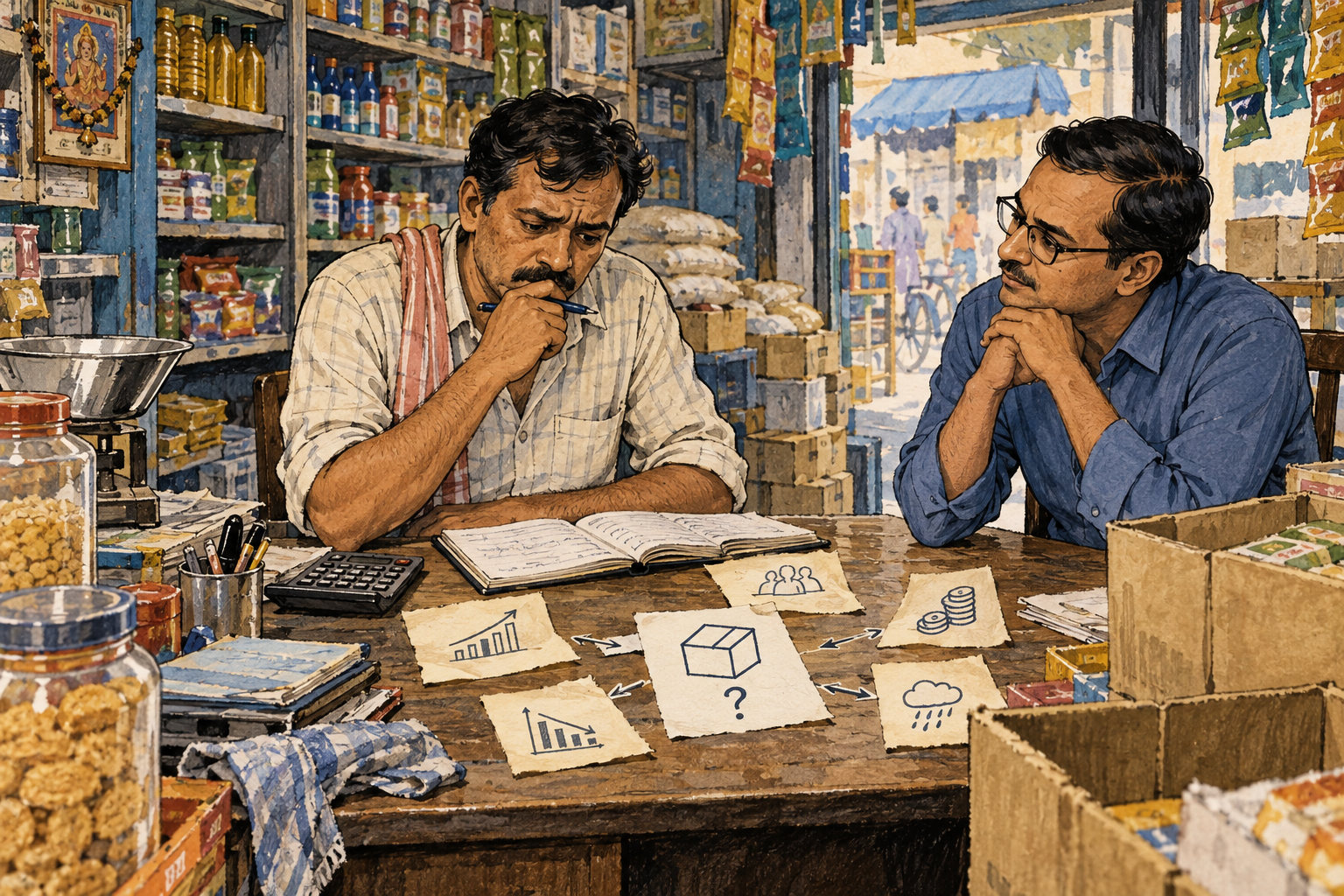
A first-time operator sees a food format working elsewhere and thinks, “This could work in my area too.”
The category may be popular. That still does not tell us whether enough nearby people will buy this version, at this price, often enough to pay rent and equipment bills.
The lease arrives before the evidence
General popularity is not local repeat demand. A founder can mistake online attention, foot traffic or enthusiasm from friends for evidence of purchases at a specific price.
The decision becomes expensive when a lease or equipment order is signed before that uncertainty is tested.
The usual moment this begins is before committing to rent or equipment. What follows is avoidable launch, rent or equipment commitments; no realized loss reported.
A busy street does not guarantee a busy counter
A busy road can have lots of people but few people who want this food at this price. Ten friends saying they would try it is not the same as ten prepaid orders from strangers.
A tiny preorder or pop-up can answer more than a long argument about footfall.
What is supported by evidence—and what is still only a hypothesis?
What the evidence says
Episode 2 is a prospective launch discussion.
No failed launch, receipt or quantitative demand evidence was supplied.
Consultancy offerings establish supply, not repeated founder pain.
What we know
- no failed outlet or loss documented
- One prospective launch Anecdotal source signal
- Evidence level
- E0 Anecdotal
- Field interviews
- Not completed Proposed in the next test
Counterargument: An owner-run preorder or pop-up may provide enough evidence without a paid researcher.
The expensive bet comes before the first sale
The cost of a bad commitment could be large, but the source does not document one. The audit model is deliberately small because founders with limited cash may be better served by spending the money on an owner-run preorder or pop-up.
Current cost, loss and research spending are insufficiently evidenced.
Who might pay: The founder would pay; willingness is unknown.
| Price to test | ₹1,500 |
|---|---|
| Direct cash cost | − ₹300 |
| Contribution before owner time | ₹1,200 |
| Owner time | 6 hours × ₹150 |
| Contribution after owner time | ₹300 |
These numbers are not a forecast. They make the hypothesis measurable and keep weak economics visible.
How first-time owners judge demand now
The founder can compare other places, take preorders or run a tiny pop-up. A paid researcher has to beat those low-cost ways of learning.
Why optimism wins over small tests
A lease and shiny equipment make the idea feel serious. The quieter work—asking for preorders, testing a menu and counting repeat buyers—can feel less exciting even though it is safer.
Concept appeal may be confused with local purchase behaviour. Founders may prefer launch activity to a disconfirming test.
What could make a test easier: Inexpensive order and payment records make small tests possible.
Test the meal before the lease
A bounded audit might help a founder design a local demand test and interpret the result before fixed commitments.
It should never turn food sales during a pilot into evidence that founders will pay for research.
Owner-run demand test
Use preorders or a tiny pop-up before fixed commitments.
Weakness: A short test may miss seasonality.
Bounded demand audit
Reconstruct evidence and propose a small test.
Weakness: Research labour may exceed the fee.
Practical boundary: Interview consent; food handling later needs an approved operator. Yes for research only.
How we’d test this for ₹1,500
Start with evidence, not a product. The experiment should answer one decision before any larger commitment.
- Participants
- 10 recent or prospective founders
- Time
- 7 days
- Research budget
- ~₹1,500
- Owner time
- 12 hours
Do recent founders show the same costly decision gap, and will any pay for a bounded audit instead of running the test themselves?
- Recruit founders.
- Reconstruct ten recent launch decisions.
- Compare alternatives and offer a draft audit scope.
Continue if
- 4 of 10 show an avoidable or uncertain commitment.
- 3 provide documents.
- 2 discuss a paid audit.
Stop if
- No costly decision gap appears.
- Founders already test adequately.
- Food sales are mistaken for audit demand.
Will you test this?
These are our proposed decision rules, not industry benchmarks.
Why a short demand test can still mislead
The need is one-off, early founders have little cash, and a short test can miss seasonality. The cheapest owner-run experiment may be the right answer.
- One-off need, limited cash and researcher credibility.
If nobody will pay for this, it is not a business—just a real problem.
Evidence snapshot
Opportunity snapshot
A public view of what is known before a solution is proposed. It is not a market-size or margin claim.
- Pain / severity
- Consequence reported; prevalence is not established.
- Who pays
- The founder would pay; willingness is unknown.
- Current alternatives
- The observed method is the founder’s own judgement and comparison with other places. A cheap pop-up may already be enough.
- Test cost
- Proposed 7-day research budget: ₹1,500.
- Main risk
- One-off need, limited cash and researcher credibility.
- Evidence
- E0 · Anecdotal.
What would change our mind? An owner-run preorder or pop-up may provide enough evidence without a paid researcher. We would also need: Will founders pay instead of testing the menu themselves?
Our current view
A useful question with only anecdotal demand evidence.
Reconstruct recent outlet decisions before offering an audit. Evidence of food demand and evidence of demand for research are different.
Next move: Interview recent founders.
Research notes
- Problem score
- 31 / 100
- Opportunity score
- 36–71 / 100
- Biggest unknown
- Will founders pay instead of testing the menu themselves?
Scores are internal research judgments, not probabilities of success.
Sources
Sources support the specific claims described here. A reported account or an operator’s existence does not validate a market-wide opportunity.
Business Mastery · Episode 2
Source conversation
Participant or facilitator account. Figures have not been independently verified.
Open source ↗Pedersen Nayak hospitality feasibility
Existing operator
Shows a larger research service; pricing and micro-outlet transferability are unknown.
Open source ↗Restaurant Coach feasibility study
Existing operator
Service analogue, not evidence that first-time founders will pay.
Open source ↗
Reality check
Does this happen in real life?
One anonymous signal helps us decide what to investigate next.
Continue exploring